Polyurethane Elastomer with Greatly Improved Abrasion Resistance

Title: POLYURETHANE WITH IMPROVED ABRASION RESISTANCE, THE METHOD FOR PREPARING THE SAME AND USE THEREOF

 Number/Link: US2013059935

Applicant/Assignee: Bayer

Publication date: 7-03-2013

Gist”: Use of polybutadiene, high in 2,3-trans butene, to improve abrasion resistance of PU elastomers

Why it is interesting: A polybutadiene (not the diol!) with a molecular weight of about 10,000 and containing 10-20% 1,2-cis butene and about 50% of 2,3-trans butene is used in an amount of up to 5% on the total formulation, resulting in a much improved abrasion resistance. It is not clear why the 2,3 trans level has to be so high – it may have to do with crystallinity and/or compatibility with the PU matrix – but no comparative examples are given. While the idea is interesting, it is not new and only a slight variation on a Dow patent of 1996: US5510054.
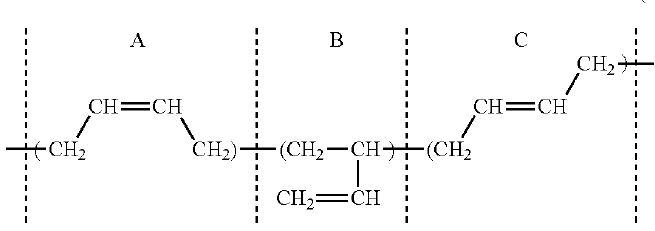
2,3 trans-, 1,2- and 2,3-cis butene units

2,3 cis-, 1,2- and 2,3-trans butene units

Insulating Elastomer-Aerogel Composites

Title: INSULATING MATERIAL COMPRISING AN ELASTOMER IMPREGNATED WITH AEROGEL-BASE

 Number/Link:  US2013022769

Applicant/Assignee: UNIV MEMPHIS

Publication date: 24-01-2013

Gist”: Elastomeric material containing aerogel ‘bodies’, useful for heat insulation.

Why it is interesting:  The elastomeric matrix material can be any kind of thermoset or thermoplastic rubber, including polyurethanes but RTV silicones are preferred. The aerogels can be organic, inorganic or hybrid, but are preferably polyurea-crosslinked silicas of any geometrical shape,  preferably 1-5mm in size with an aerogel:polymer ratio of 15:100 to 200:100 (w/w). Both insulation and mechanical properties compare favourably to ASPEN aerogel blankets. Useful for insulation of cryogenic fuel tanks a.o.

Space shuttle with PU insulated cryogenic fuel tank.

Space shuttle with PU insulated cryogenic fuel tank. (Wikimedia)

Vulcanized Rubber Containing Isocyanate-Modified Filler

Title: FILLED ELASTOMER COMPRISING POLYURETHANE

 Number/Link: WO2013004714

Applicant/Assignee: BASF  (Chinese priority)

Publication date: 10-01-2013

Gist”: “Raw” rubber is vulcanized in the presence of  precipitated silica (preferred) which has been modified with an isocyanate prepolymer (pref) containing a hydrophobic and/or rubber-reactive moiety.

Why it is interesting: The rubber can be NR, BR, SBR, IIR, EPDM, etc which is vulcanized in the conventional manner in the presence of a filler, preferably a fumed or precipitated silica.  The filler has been mixed with an isocyanate-ended prepolymer prepared from a 2000 MW polyol and a di-isocyanate.  The polyol preferably contains a hydrophobic group (e.g. from a fatty acid) or a double bond (from a unsaturated diacid).  As a result the filler will be dispersed more finely and will have a strong rubber interachtion potentially greatly improving the rubber properties.  Useful for footwear e.g.

Vulcanized Rubber Boots (Wikipedia)

Vulcanized Rubber Boots (Wikipedia)

  • Pages

  • Categories

  • Enter your email address to follow this blog and receive notifications of new posts by email.

    Join 259 other subscribers
  • Follow Innovation in PU on Twitter