Spray Foam with Increased Reactivity

Patent Title: POLYOL PREMIX COMPOSITION FOR RIGID POLYURETHANE FOAMS

 Number/Link: WO2016/162362

Applicant/Assignee: Covestro

Publication date: 13-10-2016

Gist”: Addition of dicarboxilic acid reduces cream time in amine catalyzed foams

Why it is interesting: A short cream time has advantages for rigid PU spray foam because it can reduce dripping of the material after application.  According to this invention the cream time of an amine-catalyzed, HFC-blown spray foam composition can -surprisingly-be reduced by addition of a dicarboxilic acid, preferably succinic or glutaric acid. The diacids are used in a ratio of about 2 equivalents acid to 1 equivalent of (free) amine. In the examples a clear reduction of cream time is shown compared to compositions with no diacid, a mono-acid or less than the required amount of diacid. However, all examples also contain some trimerization catalyst (2-hydroxypropyl trimethylammonium formate) next to the tert-amine catalyst (N,N-dimethylcyclohexylamine). It would be interesting to see an example without the trimerization catalyst i.m.o.
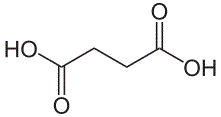
Succinic acid.

Succinic acid


Optical Polyurethane Elastomers

Patent Title: COMPOSITION FOR TRANSPARENT SHAPED BODIES BASED ON POLYURETHANE

 Number/Link: WO2016/113295

Applicant/Assignee: Covestro

Publication date: 21-07-2016

Gist”: Use of amino-chelate-tin complex as delayed action catalyst for transparent PU elastomers

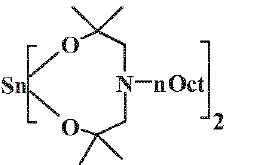
Why it is interesting: Lenses for eyeglasses are increasingly made from transparent organic polymers like polyurethane elastomers. The production requires a specialized casting process into glass moulds, followed by an exact tempering over many hours. According to this invention polyurethane elastomers, useful for the production of eyeglass lenses, can be made form a composition containing a polyol, a cycloaliphatic or araliphatic diisocyanate, an internal mould release agent and a thermo-latent catalyst. The catalyst is an inorganic metal complex comprising Sn (preferred) and at least one tert-amine containing chelating ligand. The composition is said to have a longer ‘open-time’ as the catalyst-free system.

Example of thermo-latent catalyst according to the invention

Example of thermo-latent catalyst according to the invention

Self-Crosslinkable Polyurethane

Patent Title: Self-Crosslinkable Polymer and Aqueous Dispersion Comprising Particles of the Same

 Number/Link: US2016/0159959

Applicant/Assignee: Valspar Sourcing

Publication date: 9-06-2016

Gist”: Aqueous dispersion of polyurethane having both azide and carbonyl groups in the backbone

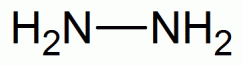
Why it is interesting: Properties of water-based PU coatings can often be improved by incorporating olefinically unsaturated groups in the polymer which can be crosslinked using radiation. According to this invention a self-crosslinking (i.e. without the need for radiation) aqueous PU coating composition can be made by incorporating both azide- and carbonyl groups into the PU backbone. When the water evaporates and the film forms these groups will react forming a hydrazone-type bond. The self-crosslinkabe polymer can be prepared by first making an NCO-ended prepolymer containing a reactive double bond, by (e.g.) reacting some of the NCO groups with hydroxyethylmethacrylate (HEMA). This prepolymer is then dispersed in water together with hydrazine and and acrylate like MMA or BA. The hydrazine will react with the NCO groups, introducing azide groups into the backbone.  The acrylate and the prepolymer are then suspension polymerized using an initiator.  The PU backbone can (optionally) contain a water dispersible group – e.g. by incorporating dimethylolpropanoic acid. The self-crosslinkable polymer is said to be especially useful for use in wood coating compositions.

Hydrazine

Hydrazine


  • Pages

  • Categories

  • Enter your email address to follow this blog and receive notifications of new posts by email.

    Join 259 other subscribers
  • Follow Innovation in PU on Twitter