Hybrid Si-PU Flexible Foams

Title: METHOD FOR PREPARING FLEXIBLE POLYURETHANE FOAM WITH HYDROLYSABLE SILANE COMPOUNDS

 Number/Link: WO2013/48999

Applicant/Assignee: DOW

Publication date: 4-04-2013

Gist”: Incorporation of hydrolysable silane compounds into flexible polyurethane foam formulation results in improved mechanical properties.

Why it is interesting: Compounds containing one or more hydrolysable silane groups Si-OR, where R denotes a hydrocarbyl group, and containing preferably at least one isocyanate-reactive group are incorporated into flexible foam formulations to introduce a secondary crosslinking mechanism. The crosslinking can occur by reaction with ambient moisture but preferably about 0.5 mole of water per mole of Si-OR group is added on top of the water used to blow the foam to the desired density. The extra crosslinking is claimed to improve mechanical properties (tear- and tensile strength and elongation-at-break) without adversely affecting the resilience and hysteris loss properties of the foam.
Polyurethane Elastomer with Greatly Improved Abrasion Resistance

Title: POLYURETHANE WITH IMPROVED ABRASION RESISTANCE, THE METHOD FOR PREPARING THE SAME AND USE THEREOF

 Number/Link: US2013059935

Applicant/Assignee: Bayer

Publication date: 7-03-2013

Gist”: Use of polybutadiene, high in 2,3-trans butene, to improve abrasion resistance of PU elastomers

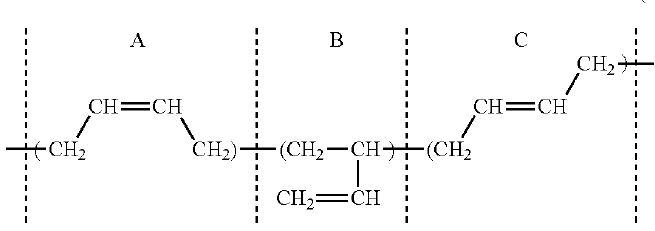
Why it is interesting: A polybutadiene (not the diol!) with a molecular weight of about 10,000 and containing 10-20% 1,2-cis butene and about 50% of 2,3-trans butene is used in an amount of up to 5% on the total formulation, resulting in a much improved abrasion resistance. It is not clear why the 2,3 trans level has to be so high – it may have to do with crystallinity and/or compatibility with the PU matrix – but no comparative examples are given. While the idea is interesting, it is not new and only a slight variation on a Dow patent of 1996: US5510054.

2,3 trans-, 1,2- and 2,3-cis butene units

2,3 cis-, 1,2- and 2,3-trans butene units

Composite Polyurethane-Polystyrene Thermal Insulation Foams

Title:  METHOD FOR PRODUCTION OF HEAT INSULATING COMPOSITE MATERIALS AND HEAT INSULATING COMPOSITEMATERIAL PRODUCED THEREBY

 Number/Link: WO2013/021324

Applicant/Assignee: HIT KONSULTING

Publication date: 14-02-2013

Gist”: Expandable polystyrene beads are added to rigid PUR or PIR foam system.

Why it is interesting: EPS beads with a softening temperature of 80-90°C are added to the isocyanate stream in an amount of 15-60% w/w to the total system. The exotherm has to be exactly right to fully expand and not degrade the EPS, and is controlled by the ratio PU/EPS.  This idea is not new, but it remains an interesting route to cheap insulation. The claim is relatively narrow so could get granted imo.

Expandable Polystyrene (Wikimedia)

Expandable Polystyrene (Wikimedia)

  • Pages

  • Categories

  • Enter your email address to follow this blog and receive notifications of new posts by email.

    Join 259 other subscribers
  • Follow Innovation in PU on Twitter