PU-Acrylate/Epoxy IPN for 3D Printing

Patent Title: PHOTOCURABLE COMPOSITIONS FOR THREE-DIMENSIONAL PRINTING

 Number/Link:  WO 2016/153711

Applicant/Assignee: Dow

Publication date: 29-09-2016

Gist”: Acrylate-capped PU prepolymer is copolymerized with epoxides using UV radiation

Why it is interesting: This case is about UV-curable compositions to make flexible materials using additive manufacturing, especially stereolithography.  A prepolymer of an isocyanate and a ‘flexible’ polyol is capped with a hydroxy-functional acrylate, then mixed with a multifunctional epoxy, a multifunctional acrylate ‘monomer’ (a crosslinker also acting as reactive diluent) and two photoinitiators:  one radical and one cationic.  In the example a 6 to 8000 Mole weight diol is capped with TDI and then with hydroxyethyl acrylate.  The prepolymer is then mixed with 3,4-Epoxycyclohexylmethyl-3,4-epoxycyclohexane carboxylate, 1,6-hexanedioldiacrylate and two photoinitiators.  After UV curing the materials had a shore A hardness between about 60 and 80 and an elongation at break between about 70 and 200.

3,4-Epoxycyclohexylmethyl-3,4- epoxycyclohexane carboxylate
3,4-Epoxycyclohexylmethyl-3,4-
epoxycyclohexane carboxylate

PET-Lignin Polyols

Patent Title: HIGH RECYCLE CONTENT POLYOLS FROM THERMOPLASTIC POLYESTERS AND LIGNIN OR TANNIN

 Number/Link: WO2016/118411

Applicant/Assignee: Resinate Materials Group

Publication date: 28-07-2016

Gist”: PET is glycolized and then reacted with lignin or tannin

Why it is interesting: This application is about ‘sustainable’ aromatic polyester polyols partly based on recycled materials and partly on biorenewable materials. According to the invention the polyols can be prepared by first glycolizing (waste) PET and subsequently reacting the mixture with lignin at 110-210°C while removing volatile condensation products.  The resulting polyols (pref) show a OH value between 40 and 400 mg KOH/g, a fn of 2-2.2 and a viscosity at 25°C of 500 to 3000 cP. In the examples polyols with up to 25 wt% lignin are shown. The polyols are said to be useful e.g. in 2K PU coating compositions.

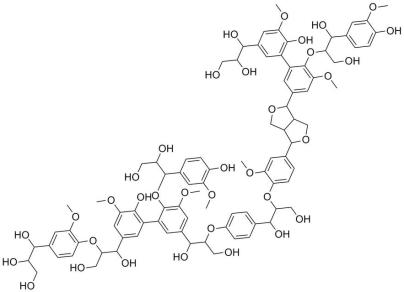
Part of a lignin structure

Part of a lignin structure

NOPs from GMOs

Patent Title: Low Polyunsaturated Fatty Acid Oils and Uses Thereof

 Number/Link: US20160194584

Applicant/Assignee: Solazyme

Publication date: 7-07-2016

Gist”: Natural oil polyols from genetically modified organisms

Why it is interesting: Natural oils usually contain significant (and variable) amounts of polyunsaturated fatty acids, i.e. fatty acids with more than one double bond in the backbone. Soybean oil for example contains up to 60% PUFAs that can easily engage in side reactions like autooxidation and polymerization, resulting in side products that contaminate the oil – and therefore the polyols derived from them.  According to this (299 page) application, oils containing >85% oleic acid and very low PUFA concentration can be made from certain genetically modified microalgae. Polyols derived from these oils by hydroxylation can be used to prepare polyurethane foams with reduced discolorouration, reduced odour, improved reproducibility and improved physical properties as compared to foams based on conventional NOPs.

Triglicerid with PUFA

Trigliceride with PUFA

  • Pages

  • Categories

  • Enter your email address to follow this blog and receive notifications of new posts by email.

    Join 259 other subscribers
  • Follow Innovation in PU on Twitter