Tack-Free Polyurethane Gels

Title: SUPPORT STRUCTURES INCLUDING LOW TACK VISCOELASTOMERIC GEL MATERIAL AND METHODS

 Number/Link: US20130011621

Applicant/Assignee: Polymer Concepts Inc.

Publication date: 10-01-2013

Gist”: Tack-free “non-bleeding” polyurethane gels by plasticizing a low-hardblock PU system with oils.

Why it is interesting: Polyurethane gels are often produced from low NCO-index systems, or other systems comprising ‘loose’ chains causing tackiness. Alternatively plasticizers can be used which can exude or ‘bleed’ especially at elevated temperatures.  This case claims a tack-free and non-bleeding gel.  In the example a low hardblock, index 98 system is plasticized by a combination of soy oil and epoxidized soy-oil, together with some 500cS silicon oil. Instead of natural oils a combination with hydrocarbon oil is claimed as well.   If true, this would be an interesting system, but it is hard to believe that the oils will not bleed over time. Especially the hydrocarbons.

Excercise Ball from Tack-Free PU gel
Excercise Ball from Tack-Free PU gel

Self-Healing Polyurethanes, Polyureas and Polyimides

Title: SELF-HEALING POLYMER MATERIALS FOR WIRE INSULATION, POLYIMIDES, FLAT SURFACES, AND INFLATABLE STRUCTURES

 Number/Link: WO2012174325

Applicant/Assignee: NASA

Publication date: 20-12-2012

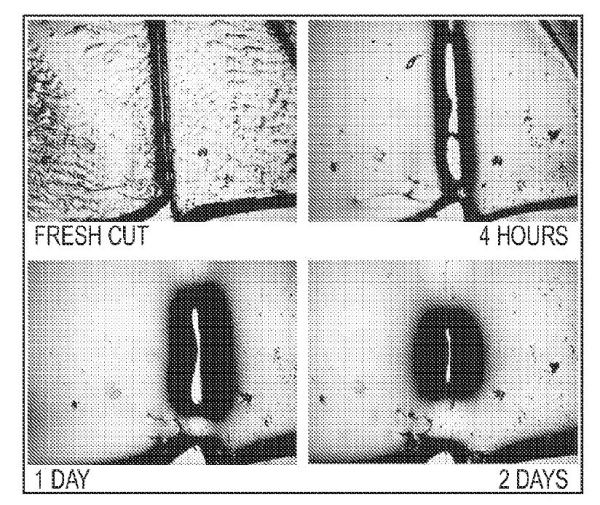
Gist”: A low molecular weight polyurethane or polyurea material, prepared by reacting IPDI and a polysiloxane diol or diamine in such a way that it flows at about 23°C, shows self-healing properties. Other ’embodiments’ of the invention are concerned with self-healing polyimides containing microcapsules comprising polyimide oligomers (“polyamic acid”).

Why it is interesting: Films of the self-healing PU with a thickness up to 5mm will flow together again after being cut. The material can be laminated between 2 structural layers and used for cable and wire encapsulation e.g.
This is an interesting but very confusing and hard-to-read patent application describing at least 2 different inventions (“non-unity”) and one would expect it to be split-up.

selfhealing

Self-Healing Polymer Film

Thermoplastic Polyurethanes from Polyesters Based on “Bio”-Propanediol.

Title: THERMOPLASTIC POLYURETHANE WITH REDUCED TENDENCY TO BLOOM FROM A BIO-BASED GLYCOL

 Number/Link: WO2012173911

Applicant/Assignee: Lubrizol

Publication date: 20-12-2012

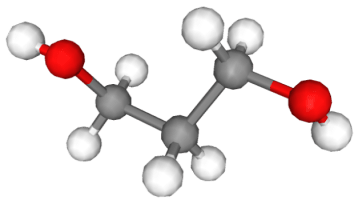
Gist”: TPUs with less tendency to “bloom” are prepared from diisocyanate, diol chain extender and a polyester polyol based on 1,3-propanediol and adipic acid.

Why it is interesting:  “Blooming” is an undesirable effect where TPU  becomes ‘hazy’ or ‘fogged’ as a consequence of non-reacted species exuding to the surface. It is known that cyclic esters, which are a by-product of polyester polyol production, contribute greatly to this effect. It is also known that 1,3-propanediol and 1,6-hexandiol based polyesters show less cyclic esters than e.g. DEG based polyesters (see p4 of WO2012125353 to Stepan). So, while still interesting, this case is not surprising.

1,3-propanediol

1,3-propanediol

  • Pages

  • Categories

  • Enter your email address to follow this blog and receive notifications of new posts by email.

    Join 259 other subscribers
  • Follow Innovation in PU on Twitter