Polyurethane/Polyurea Elastomers from 2,4′-MDI and MDA

Title: MOLDED POLYURETHANE ELASTOMER PARTS MADE OF DIPHENYLMETHANE DIISOCYANATE-BASED NCO PREPOLYMERS AND METAL SALT COMPLEXES, AND A METHOD FOR PRODUCING SAME

 Number/Link: US2013267655

Applicant/Assignee: Bayer

Publication date: 10-10-2013 (priority PCT/DE)

Gist”: Molded PU/PUA elastomers are prepared from a 2,4′-MDI based prepolymer cured with blocked MDA

Why it is interesting: A prepolymer with an NCO content between 3 to 7% is prepared from MDI containing more than 97% of the  2,4′ isomer together with a diol with an OH value of about 100.  (e.g a PTMEG or a polycaprolacton).  The prepolymer is then cured with a salt-complexed diphenylmethanediamine (“blocked MDA”). Because of it’s relatively low viscosity and long potlife the system allows for the production of thick-walled, bubble-free molded elastomers.  Probably because there is less premature polyurea phase separation (due the 2,4′-MDI) the system cures homogeneously.

4,4'-MDA

4,4′-MDA

Over-Indexed and Crosslinkable Thermoplastic Polyurethane

Title: METHOD FOR MAKING OVER-INDEXED THERMOPLASTIC POLYURETHANE ELASTOMER PRECURSOR AND THERMOPLASTIC POLYURETHANE ELASTOMER MADE FROM THE PRECURSOR

 Patent Number & Link: WO2013/103633

Applicant/Assignee: Nike

Publication date: 11-07-2013

Gist”: A TPU is produced at an NCO index of about 110 comprising an unsaturated chain extender .  The material can be injection moulded and subsequently cured with moisture and free radical polymerization.

Why it is interesting: A thermoplastic PU ‘precursor’ is prepared by reactive extrusion of  a polyol (e.g. a 2000MW polytetramethylene ether glycol), an unsaturated chain extender (e.g. trimethylolpropane monoallyl ether – TMPME), optional additives and MDI at an NCO index of 110 to 115 (preferred). After drying, the resulting pellets can be injection- or compression moulded and then cured by moisture and by heat or UV radiation. The resulting PU-polyurea is claimed to have improved toughness, durability and ‘scuff resistance’ compared to conventional TPUs.  The material appears to have been developed for the golf ball industry.  Nike has filed at least two related ‘golf ball patents’: WO2013/103673 and WO2013/103669.

TMPME: unsaturated chain extender used in the invention

TMPME: unsaturated chain extender used in the invention

Polyurethane for Precision Lenses

Title: POLYURETHANE HAVING LOW VOLUME SHRINKAGE

 Number/Link: US2013/116357

Applicant/Assignee: Bayer

Publication date: 9-05-2013 (priority PCT/DE)

Gist”: Modified m-XDI mixtures are used to prepare solvent-free polyurethane or polythiourethane with high refractive index, low dispersion and low volume shrinkage.

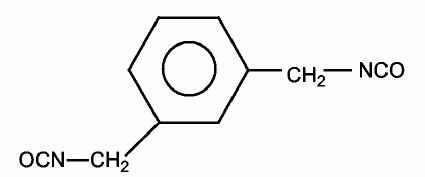
Why it is interesting: Production of polyurethane and (esp.) polythiourethane for optical applications is well known. Usually araliphatic isocyanates are used, often together with mercapto-functional compounds resulting in materials with high refractive index, low dispersion and low discolouration. Bayer has found that by modifying araliphatic diisocyanates, e.g. m-xylenediisocyanate, by partial trimerization or by partly converting into allophanate or biuret (after adding some diol or water respectively) optical polyurethanes or polythiourethanes can be produced without the use of solvent and with less shrinkage.  The materials are therefore more useful for precision optics.

1,3-bis(isocyanatomethyl)benzene (m-XDI)

1,3-bis(isocyanatomethyl)benzene (m-XDI)

  • Pages

  • Categories

  • Enter your email address to follow this blog and receive notifications of new posts by email.

    Join 259 other subscribers
  • Follow Innovation in PU on Twitter