TPU with Crystalline Chain Ends

Title: ARTICLES MADE FROM THERMOPLASTIC POLYURETHANES WITH CRYSTALLINE CHAIN ENDS

 Number/Link: WO2014/189993

Applicant/Assignee: Lubrizol

Publication date: 27-11-2014

Gist”: TPU with improved processability by using crystallizing chain stoppers.

Why it is interesting: While thermoplastic polyurethanes are very interesting engineering materials with an attractive combination of properties, their main drawback is the often very narrow processing window. Especially soft TPUs are both difficult to produce and process. According to this invention TPUs, including soft TPUs, with greatly improved processing properties can be produced by incorporating crystallizing chain stoppers. In the examples straight chain hydrocarbon monols with 33 and 63 carbons are used as chain stoppers in an amount of about 1 to 10% w/w on the total composition.
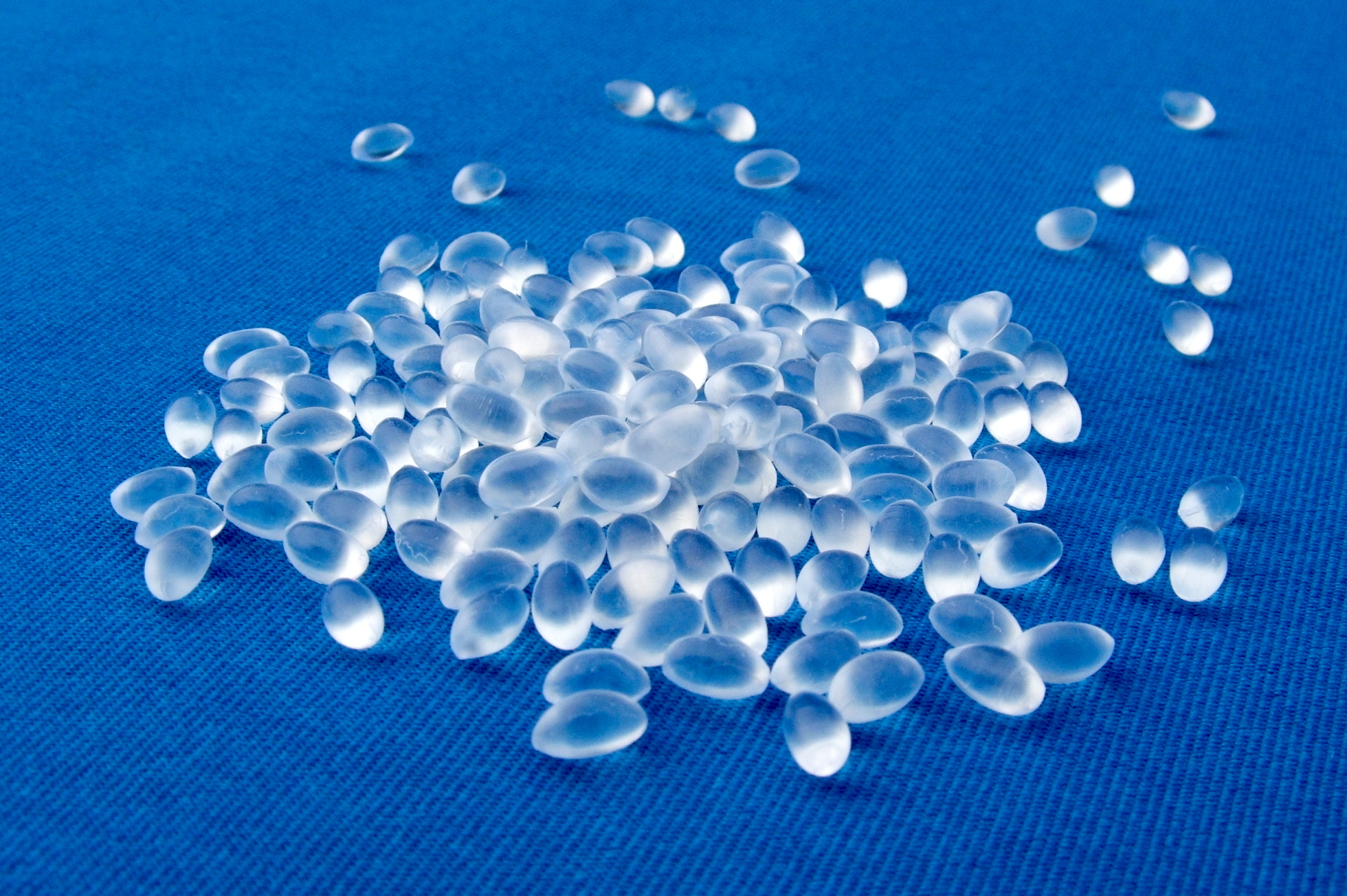
TPU pellets

TPU pellets

Poly (Urethane-Urea) Elastomers from High 2,6-TDI

Title: Polyurethane Elastomers Based on TDI Prepolymers Enriched in the 2,6-TDI Isomer Cured with Trimethylene Glycol Di-(para Amino Benzoate)

 Number/Link: US2014/0309397

Applicant/Assignee: Anderson Development

Publication date: 16-10-2014

Gist”: Elastomers are prepared from TDI containing a high amount of the 2,6 isomer.

Why it is interesting: Commercially available toluene diisocyanate (TDI) usually comes in the 80/20 or the 65/35  2,4/2,6 isomer blend. It is known that higher 2,6 levels result in stiffer hardblocks and a different reaction profile because of the (initially) equal reactivity of the isocyanate groups. According to this invention elastomers prepared from TDI with a 2,6 content of (most preferred) at least 60% results in superior green strength and dimensional stability. High 2,6 TDI-PTMEG prepolymers cured with trimethylene glycol di(p-aminobenzoate) (TGDBA) should even have a superior tear strength and upper hardness limit compared to MDI based elastomers.

TGDBA

TGDBA

Thermoplastic PU-PS Graft Copolymers

Title: POLYURETHANE-BASED POLYMER COMPOSITION

 Number/Link: WO2014/147194

Applicant/Assignee: BASF

Publication date: 25-09-2014

Gist”: TPU microparticles react with styrene monomer resulting in a TPU-PS copolymer.

Why it is interesting: Blends of TPU with polystyrene are known, but compatibility is low and PS to TPU ratio therefore needs to be low as well  to prevent ‘delamination’ of injection moulded parts.  According to this patent application it is however possible to graft the PS onto TPU such that much higher PS/TPU ratio’s can be obtained. The TPU needs to be MDI-based and have a relatively low hardblock content and softening temperature. Apparently the PS grafts onto the MDI methylene groups which form radicals easily. In an example TPU micropellets are swollen in styrene monomer at low temperature together with dicumulperoxide as a radical initiator. The swollen particles are then dispersed in water together with an emulsifier and heated under pressure to form a 60-40 TPU-PS copolymer. A solvent-based process is also exemplified.  The resulting polymers are especially useful for injection moulded parts such as spring-aids.

MDI radical

MDI radical

  • Pages

  • Categories

  • Enter your email address to follow this blog and receive notifications of new posts by email.

    Join 259 other subscribers
  • Follow Innovation in PU on Twitter