Optical Polyurethane Elastomers

Patent Title: COMPOSITION FOR TRANSPARENT SHAPED BODIES BASED ON POLYURETHANE

 Number/Link: WO2016/113295

Applicant/Assignee: Covestro

Publication date: 21-07-2016

Gist”: Use of amino-chelate-tin complex as delayed action catalyst for transparent PU elastomers

Why it is interesting: Lenses for eyeglasses are increasingly made from transparent organic polymers like polyurethane elastomers. The production requires a specialized casting process into glass moulds, followed by an exact tempering over many hours. According to this invention polyurethane elastomers, useful for the production of eyeglass lenses, can be made form a composition containing a polyol, a cycloaliphatic or araliphatic diisocyanate, an internal mould release agent and a thermo-latent catalyst. The catalyst is an inorganic metal complex comprising Sn (preferred) and at least one tert-amine containing chelating ligand. The composition is said to have a longer ‘open-time’ as the catalyst-free system.
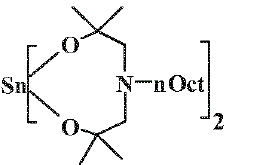
Example of thermo-latent catalyst according to the invention

Example of thermo-latent catalyst according to the invention

Polyurethane Elastomer with High Dielectric Constant

Patent Title: DIPOLE-MODIFIED POLYURETHANE, METHOD FOR PRODUCING SAME, AND USE THEREOF IN THE PRODUCTION OF CAST ELECTROACTIVE POLYURETHANE-BASED ELASTOMER FILMS

 Number/Link: WO2016102320  (German)

Applicant/Assignee: Covestro

Publication date: 30-06-2016

Gist”: A molecule with high dipole moment is incorparted in the PU backbone

Why it is interesting: According to this invention a polyurethane with an increased dielectric constant can be prepared by first reacting an isocyanate (f>2)with a hydroxyl-functional dipole.  This ‘dipole-modified’ isocyanate is then used in a (preferred) amount of 5-10% on the rest of the isocyanate of an elastomer formulation.  The dipole is of the form HO-R-D-X-A, where  D is an electron donor, A is an electron acceptor and X is a residue with a delocalized electron system.  In an example N-2-hydroxyethyl-N-methyl-4-nitroanilin is reacted with a biuret based on HDI to make the ‘dipole-modified’ isocyanate. Polyurethane elastomer films with high dielectric constant can be used as electromechanical transducers in sensors, actuators, artifical muscle etc..

N-2-Hydroxyethyl-N-Methyl-4-Nitroanilin

N-2-Hydroxyethyl-N-Methyl-4-Nitroanilin

+

Polyurethane-Acrylate Plastisol

Patent Title: ACRYLIC-URETHANE IPN PLASTISOL

 Number/Link: US2016/0152857

Applicant/Assignee: Polyone

Publication date: 2-06-2016

Gist”: Plastisols from blocked-iso grafted acrylate in plasticizer

Why it is interesting:
Conventional plastisols are suspensions of PVC particles in a (usuallly phthalate-) plasticizer. The suspension can be cured by heating, which results in a plasticized elastomer.  Plastisols are used for coatings of e.g. car underbodies and for ‘screen printing’ of textiles. According to this invention a non-PVC plastisol can be produced by dispersing core-shell acrylate polymer particles (Mn between 300,000 and 1,000,000) with blocked isocyanate groups grafted to the backbone into a plasticizer, preferably into dioctylphthalate, together with a latent amine crosslinker like adipic dihydrazide. No information is given about the blocking agent but the plastisol is said to cure at 130-170°C and be especially suited for textile printing.

Adipic dihydrazide

Adipic dihydrazide

  • Pages

  • Categories

  • Enter your email address to follow this blog and receive notifications of new posts by email.

    Join 259 other subscribers
  • Follow Innovation in PU on Twitter