Self-Healing Polyurethanes

Title: SELF-HEALING POLYURETHANES

 Number/Link: WO2015/067833 (Spanish)

Applicant/Assignee: Fundacion Gaiker

Publication date: 14-05-2015

Gist”: Self-healing polyurethanes coatings can be prepared using dihydroxy coumarin derivatives

Why it is interesting: Self-healing polymers have been made before using e.g. microencapsulated ‘healing agents’ or supramolecular chemistry such as hydrogen-bond formation.  This patent application relates to polyurethanes having photochemical self-healing properties, which, in contrast to previous systems, have the advantage of allowing for multiple recoveries and for (potentially) being transparent. The self-repairing PU systems are based on the photodimerization and photocleavage reactions of coumarine-derivatives as shown in the scheme below.  Dihydroxy derivatives of coumarine can be built into PU coatings sytems. Damaged coatings can then be radiated with light of a wavelength of (pref.) 254nm to cleave coumarin dimers present, followed by radiation of about 340nm to (re-)form the dimers and repair the coating.
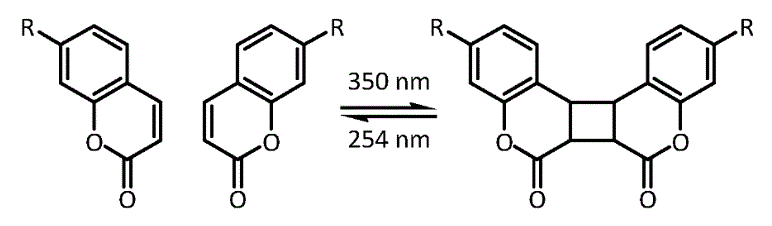
Photodimerization and -cleavage of coumarine derivatives

Photodimerization and -cleavage of coumarine derivatives

Polyurethane Coating for Frac Tanks

Title: SPRAYABLE POLYURETHANE BASED PROTECTIVE COATING

 Number/Link:  WO2015/050811

Applicant/Assignee: Dow

Publication date: 9-04-2015

Gist”: Use of butylene oxide polyols in sprayable coating composition

Why it is interesting: The hydraulic fracturing fluids used in ‘fracking’ operations are stored and transported in so-called ‘frac tanks’. Because fracking fluids can contain highly corrosive compounds such as HCl and solvents such as toluene and xylene, the tanks need a protective coating with a high chemical resistance. According to this application such a coating can be accomplished using a sprayable 2 component system comprising polyols with a high butylene oxide (BO) content, e.g. polyols prepared from 80% butylene oxide and 20% propylene oxide (PO) with a molecular weight of about 2000 and a functionality of 2. In the first component the BO/PO polyol is prepolymerized with an isocyanate e.g. MDI, while used as such in the second component. The two components are prepared such that they both show a similar viscosity of less than 1500 cP at 25°C, so that the coating composition is sprayable.

Frac tank.

Frac tank.

Superhydrophobic Polyurethane Coatings

Title: POLYMERS FOR MAKING SUPERHYDROPHOBIC SURFACES

 Number/Link: WO2015/047196

Applicant/Assignee: AGENCY FOR SCIENCE, TECHNOLOGY AND RESEARCH

Publication date: 2-04-2015

Gist”: A comb polymer with hydrophobic side chains and an isocyanate-reactive backbone is reacted with an NCO-ended prepolymer.

Why it is interesting: Superhydrophobic surfaces show a contact angle (vs water) of 150° or more. Water therefore forms almost perfectly spherical droplets on such a surface which easily roll off: the so-called “lotus-effect”. Superhydrophobic surfaces can find important applications in e.g. automotive and aviation industries. The current invention relates to a superhydrophobic coating composition comprising a hydrophobic comb-polymer having an NCO-reactive backbone together with a polyurethane prepolymer.  The comb polymer is prepared by alkylating an unsaturated epoxy monomer with a nucleophile comprising a C8 to C20 alkyl group, followed by polymerization. The resulting comb polymer can then be combined with an NCO-ended polyurethane prepolymer to make a superhydrophobic coating composition. In an example hexadecylamine is reacted with glycidylmethacrylate resulting in 3-(hexadecylamino)-2-hydroxypropylmethacrylate which is then polymerized into a comb-like polymer. After separation and drying the comb polymer is combined with a commercial (solvent-based) polyurethane prepolymer to make the coating composition.

Glycidylmethacrylate

Glycidylmethacrylate


  • Pages

  • Categories

  • Enter your email address to follow this blog and receive notifications of new posts by email.

    Join 259 other subscribers
  • Follow Innovation in PU on Twitter