Cooperative Catalyst System for NIPU

Title: Catalyst for Non-Isocyanate Based Polyurethane

 Number/Link:US2015/247004

Applicant/Assignee: Dow; Univ. Northwestern

Publication date: 3-09-2015

Gist”: The cyclocarbonate-amine reaction is catalysed by a lewis acid/lewis base combination

Why it is interesting: It is well known that polyhydroxyurethanes can be produced from cyclic carbonates and amines.  These “nonisocyanate polyurethanes” can have advantages over conventional polyurethanes, e.g. as coatings with improved chemical resistance. The reactivity of (especially 5-ring)  cyclocarbonates is however much lower than that of isocyanates making the reaction much less practical.  According to this invention that problem can be solved by using a ‘cooperative’ catalyst system consisting of a lewis acid and an organic lewis base. In an example a difunctional cyclocarbonate-capped prepolymer is reacted with 1,3-cyclohexane-bis(methylamine) catalysed by a mixture of  lithium trifluoromethanesulfonate and triazabicyclodecene.
It has been noted before in this blog that Dow, as one of the major isocyanate producers, also appears to be interested in non-iso PU.

Triazabicyclodecene.
Triazabicyclodecene.

Modified Polyols for Improved PU Adhesives

Title: POLYOL COMPOSITIONS FOR HOT MELT ADHESIVES

 Number/Link:WO2015/127276

Applicant/Assignee: IFS Industries

Publication date: 27-08-2015

Gist”: Polyester diols are partially capped with bulky glycidyl esters

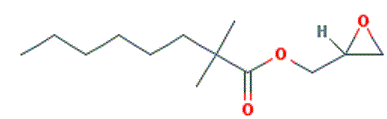
Why it is interesting: According to this invention polyester (or polyether) polyols which are partially capped with a bulky glycidyl ester can be used to improve the adhesive properties of (reactive) polyurethane (hotmelt) adhesives. Specifically the adhesion to materials with low surface energies like ABS or polyolefines is said to improve. In the examples polyester diols prepared from adipic acid and hexanediol with a Mn of about 3000 are partially capped with the glycidyl ester of neodecanoic acid (“Versatic Acid 10”) and used in PU adhesive formulations.

Glycidyl ester of neodecanoic acid

Glycidyl ester of neodecanoic acid

Urethane-Acrylate Hybrids From Thiol-Ene Chemistry

Title: POLYURETHANE (METH) ACRYLATES USING MODIFIED HYDROXYTHIOLS

 Number/Link: US2015/0232422

Applicant/Assignee: Dymax Oligomers and Coatings

Publication date: 20-08-2015

Gist”: A dihydroxythiol is reacted with an acrylate and then with diisocyanate and hydroxyacrylate

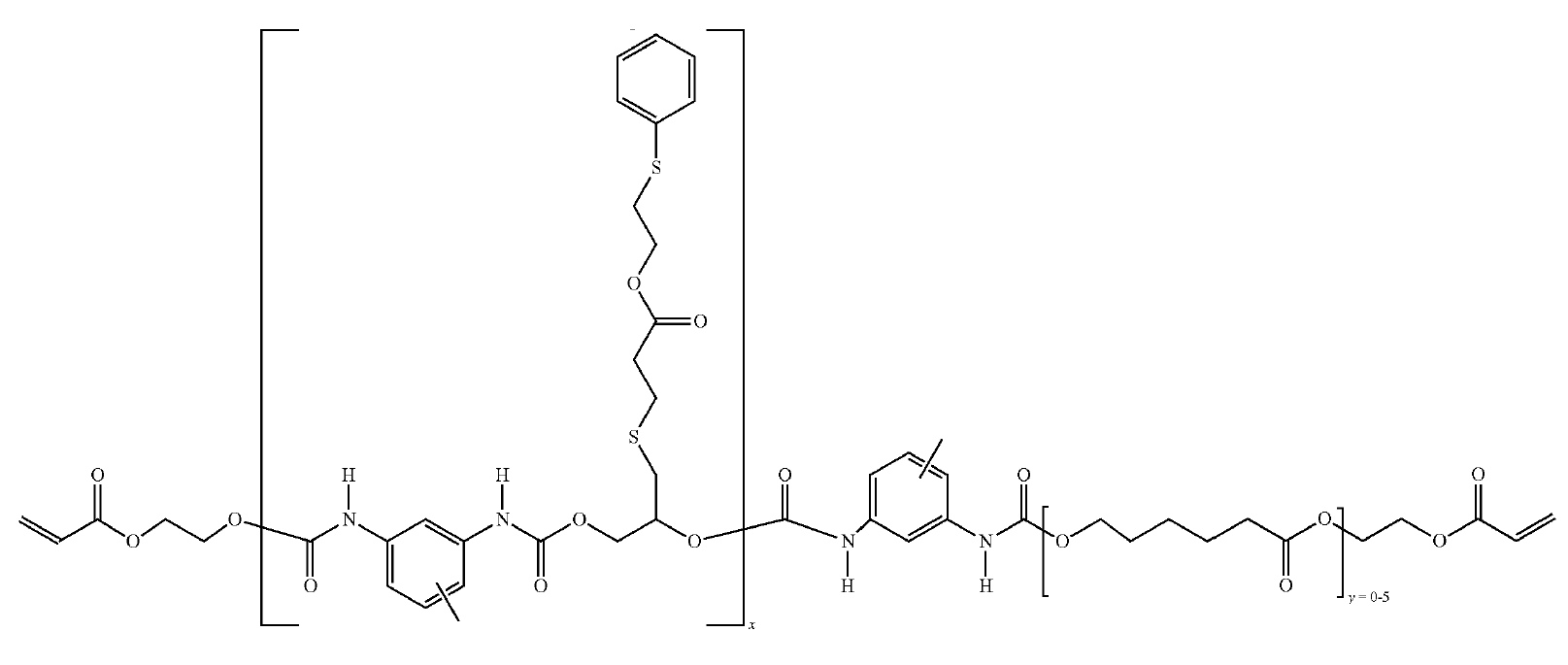
Why it is interesting: This invention relates to radically polymerizable urethane oligomers which are useful as adhesives or coatings. The oligomers are prepared in two stages:  first a dihydroxy thiol is reacted with an acrylate resulting in a diol which is then reacted with an excess diisocyanate and then with hydroxyacrylates.  For example: thioglycerol is reacted with phenyltioethylacrylate.  The resulting diol is then further reacted with TDI and subsequently with polycaprolactonacrylate and hydroxyethylacrylate resulting in the structure below. The urethane oligomers can be used for coatings or adhesives which are said to have improved properties over the existing art, like improved thermal resistance.

A urethane-acrylate oligomer according to the invention

A urethane-acrylate oligomer according to the invention

  • Pages

  • Categories

  • Enter your email address to follow this blog and receive notifications of new posts by email.

    Join 259 other subscribers