Rigid Polyurethane Foam Containing Expandable Particles

Title: Highly Insulating Polyurethane Foam and Method for Manufacturing Same

 Number/Link:US2013/0150470

Applicant/Assignee: Cheil Industries

Publication date: 13-06-2013 (priority PCT/KR)

Gist”: Rigid foams comprising thermally expandable particles which penetrate cell walls and which are covered with an infrared absorbing filler show improved insulation properties.

Why it is interesting: The invention claims to improve insulation properties of rigid foams by including about 5% (on the total resin) of organic thermally expandable particles with a diameter of about 5 μm before expansion and of about 50 μm after expansion. A filler chosen from carbon black, graphite, carbon nanotubes and the like is added as well. After the foam is formed the expanded particles penetrate the cell walls, are supposedly covered with the filler and are believed to reduce the radiation component of the thermal conductivity. Foam properties given in the examples show a density of about 35 kg/m³ with a thermal conductivity of about 0.0160 kcal/m.h.ºC (or about 0.019 W/m.K if I converted this correctly).

fig 2 form the patent.  Large circles are expanded particles, smaal circles is filler.

Fig 2 form the patent: large circles are the expanded particles, the small circles represent the filler.
Hybrid PU-PF Rigid Foams

Title: RIGID POLYURETHANE FOAM

 Number/Link: EP2591034A1

Applicant/Assignee: BASF

Publication date: 15-05-2013  (priority PCT/EP)

Gist”: Use of novolac polyols in rigid (spray) foams to improve reactivity and flammability properties.

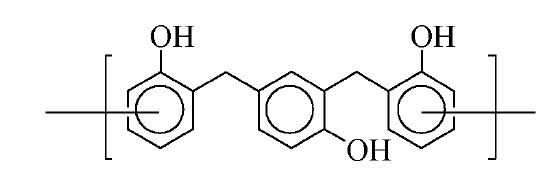
Why it is interesting: ‘Novolacs’ are phenol-formaldehyde (PF) resins which are produced at a p:f ratio of  >1 (as opposed to ‘resols’ where this ratio is <1) Novolacs are therefore phenol (OH) ended and can be used together with isocyanates to prepare hybrid polyurethanes. In this case novolacs with a functionality of about 4-8 are used together with conventional rigid foam polyol(s) in which the novolacs are dissolved (after heating and opt. melting) in an amount of about 40%. Together with polymeric MDI, water and conventional additives rigid (spray) foams are produced with improved flammibility, smoke, scorching and reactivity properties.

Novolac resin

Novolac resin

Solid Polyurethane Electrolyte

Title: POLYURETHANE BASED MEMBRANES AND/OR SEPARATORS FOR ELECTROCHEMICAL CELLS

 Number/Link: WO2013/062990

Applicant/Assignee: Lubrizol

Publication date: 2/05/2013

Gist”:  TPU prepared from a DEG-adipate polyester diol, HQEE and 4,4′-MDI can be used as Li ion-conducting electrolytes  in electrochemical cells.

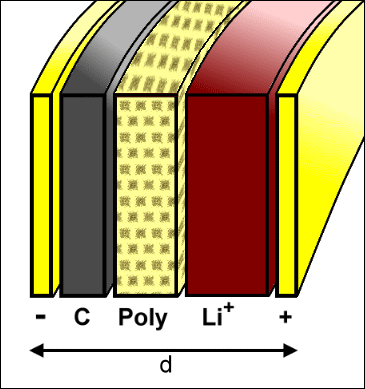
Why it is interesting: Because of the rapidly increasing use of phones, tablets, electric cars etc. research into improved batteries is a very hot topic. Many modern batteries use Li+-conducting seperators or ‘membranes’ with specific conductivity, solvent swelling and heat-resistance properties.  According to this invention  improved separator membranes can be produced from (a surprisingly simple) thermoplastic polyurethane based on (preferably) 4,4′-MDI, hydroquinone bis (hydroxyethyl)ether as chain extender and a DEG-adipic polyester diol with a MW of 2000 to 3000.  Lithium conductivity can (optionally) be further improved by incorporating Li+-conducting solids like Li-Borates, Li- silicates, Li salts or complexes and the like.

Schematic Li-polymer battery.

Schematic Li-polymer battery.

  • Pages

  • Categories

  • Enter your email address to follow this blog and receive notifications of new posts by email.

    Join 259 other subscribers
  • Follow Innovation in PU on Twitter