Isocyanate-Free Polyurethanes Using Azide-Alkyne Click Chemistry

Title: SYNTHESIS OF POLYURETHANE POLYMERS VIA COPPER AZIDE-ALKYNE CLICK CHEMISTRY FOR COATINGS, ADHESIVES, SEALANTS AND ELASTOMER APPLICATIONS

 Number/Link: WO2014/122153

Applicant/Assignee: Sika

Publication date: 14-08-2014

Gist”: Polyurethane prepolymers capped with azides and alkynes are reacted using copper catalysis.

Why it is interesting: Because of safety, health and envriromental issues, isocyanate-free systems have clearly been gaining in importance the last few years.  Especially for coatings, adhesives and OCF applications, alternative curings systems are being developed. In the current invention an isocyanate-free system is based on the reaction between a prepolymer having at least two azide groups and a prepolymer having at least two alkyne groups. The reaction is copper catalyzed such that it can be performed at ambient temperature. The first prepolymer is (pref.)  prepared by reacting an isocyanate ended prepolymer with glycidol (2,3-epoxy-1-propanol) and subsequently with sodium azide. The second prepolymer is similarly prepared by reacting an isocyanate ended prepolymer with propargyl alcohol (2-propyn-1-ol).  The systems are said to be especially useful for roof coatings.

Example of an azide-alkyne reaction resulting in 1,4-disubstituded triazoles.
Example of an azide-alkyne reaction resulting in 1,4-disubstituded triazoles.


Highly Stable Isocyanate Dispersions

Title: STORAGE-STABLE HYDROPHILIC POLYISOCYANATES

 Number/Link: WO2014/053269   (German)

Applicant/Assignee: Evonik

Publication date: 10-04-2014

Gist”: A uretdion-containing isocyanate prepolymer is reacted with a neutralized aminealkylsulfonic acid to produce a novel hydrophilic (latent) isocyanate which can be used in stable aqueous dispersions.

Why it is interesting: Aqueous dispersions of isocyanates are useful in many applications as adhesives, binders, crosslinkers etc, but usually suffer from a relatively short shelf life.  Dispersions prepared according to the current invention supposedly lose less than 30% of their initial NCO value after 12 weeks storage at 50°C. In an example an aceton-solution of  an IPDI-uretdion prepolymer with an isocyanate content of 1.5% is reacted with the sodium salt of an aminealkylsulfonate in water to an NCO value of 0.1%. After removal of the aceton the resulting dispersion had a latent isocyanate content of 4.5%

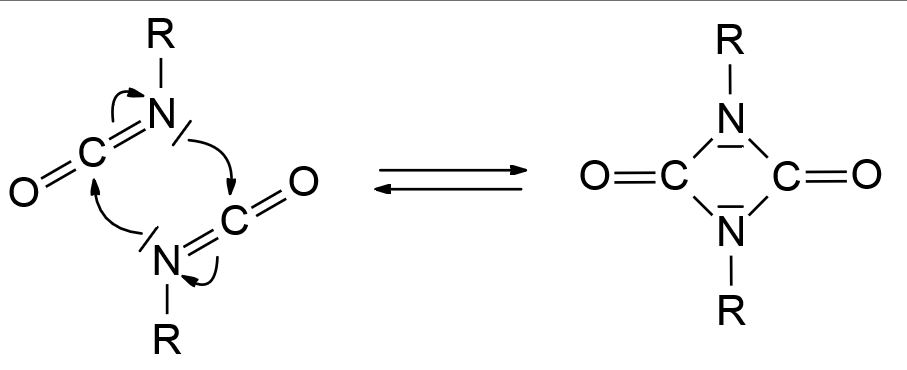
Dimerization of isocyanate to uretdion.

Reversible dimerization of isocyanate to uretdion.

  • Pages

  • Categories

  • Enter your email address to follow this blog and receive notifications of new posts by email.

    Join 259 other subscribers
  • Follow Innovation in PU on Twitter