Self-Crosslinkable Polyurethane

Patent Title: Self-Crosslinkable Polymer and Aqueous Dispersion Comprising Particles of the Same

 Number/Link: US2016/0159959

Applicant/Assignee: Valspar Sourcing

Publication date: 9-06-2016

Gist”: Aqueous dispersion of polyurethane having both azide and carbonyl groups in the backbone

Why it is interesting: Properties of water-based PU coatings can often be improved by incorporating olefinically unsaturated groups in the polymer which can be crosslinked using radiation. According to this invention a self-crosslinking (i.e. without the need for radiation) aqueous PU coating composition can be made by incorporating both azide- and carbonyl groups into the PU backbone. When the water evaporates and the film forms these groups will react forming a hydrazone-type bond. The self-crosslinkabe polymer can be prepared by first making an NCO-ended prepolymer containing a reactive double bond, by (e.g.) reacting some of the NCO groups with hydroxyethylmethacrylate (HEMA). This prepolymer is then dispersed in water together with hydrazine and and acrylate like MMA or BA. The hydrazine will react with the NCO groups, introducing azide groups into the backbone.  The acrylate and the prepolymer are then suspension polymerized using an initiator.  The PU backbone can (optionally) contain a water dispersible group – e.g. by incorporating dimethylolpropanoic acid. The self-crosslinkable polymer is said to be especially useful for use in wood coating compositions.
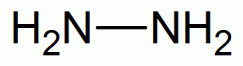
Hydrazine

Hydrazine


Urethane-Acrylate Latex

Patent Title: HIGH SOLIDS, LOW VISCOSITY URETHANE-LINKAGE CONTAINING LATEX AND METHOD OF PRODUCTION THEREOF

 Number/Link: WO2015/195466

Applicant/Assignee: Arkema

Publication date: 23-12-2015

Gist”: Simultaneous emulsion polymerization of acrylate, hydroxyacrylate and diisocyanate

Why it is interesting: According to this invention a low viscosity and high solid-content latex, containing urethane bonds, can be produced by emulsion polymerization of a diisocyanate  and a mixture of ethylenically unsaturated monomers some of which are isocyanate-reactive. In an example H12MDI is emulsified in water together with hydroxyethyl acrylate, a mixture of other acrylate monomers and an appropriate surfactant.  The emulsion is then polymerized using a peroxide. The resulting latex had a solid content of 52% at a visosity of 480 cP.  The latex is said to be especially useful for coatings with improved chemical resistance and toughness.

Hydroxyethyl acrylate

Hydroxyethyl acrylate

Superhydrophobic Polyurethane Coatings

Title: POLYMERS FOR MAKING SUPERHYDROPHOBIC SURFACES

 Number/Link: WO2015/047196

Applicant/Assignee: AGENCY FOR SCIENCE, TECHNOLOGY AND RESEARCH

Publication date: 2-04-2015

Gist”: A comb polymer with hydrophobic side chains and an isocyanate-reactive backbone is reacted with an NCO-ended prepolymer.

Why it is interesting: Superhydrophobic surfaces show a contact angle (vs water) of 150° or more. Water therefore forms almost perfectly spherical droplets on such a surface which easily roll off: the so-called “lotus-effect”. Superhydrophobic surfaces can find important applications in e.g. automotive and aviation industries. The current invention relates to a superhydrophobic coating composition comprising a hydrophobic comb-polymer having an NCO-reactive backbone together with a polyurethane prepolymer.  The comb polymer is prepared by alkylating an unsaturated epoxy monomer with a nucleophile comprising a C8 to C20 alkyl group, followed by polymerization. The resulting comb polymer can then be combined with an NCO-ended polyurethane prepolymer to make a superhydrophobic coating composition. In an example hexadecylamine is reacted with glycidylmethacrylate resulting in 3-(hexadecylamino)-2-hydroxypropylmethacrylate which is then polymerized into a comb-like polymer. After separation and drying the comb polymer is combined with a commercial (solvent-based) polyurethane prepolymer to make the coating composition.

Glycidylmethacrylate

Glycidylmethacrylate


  • Pages

  • Categories

  • Enter your email address to follow this blog and receive notifications of new posts by email.

    Join 259 other subscribers
  • Follow Innovation in PU on Twitter