PU Sealants using Michael Addition Chemistry

Title: MICHAEL ACCEPTOR-TERMINATED URETHANE-CONTAINING FUEL RESISTANT PREPOLYMERS AND COMPOSITIONS THEREOF

 Number/Link: US2015/0252232

Applicant/Assignee: PRC-DeSoto

Publication date: 10-09-2015

Gist”: A PU prepolymer is capped with Michael accepting groups and then cured with a dithiol

Why it is interesting: This invention is about sulphur containing PU sealants with properties acceptable for the aerospace industry. A bis(vinylsulfonyl)- terminated urethane-polythioether prepolymer is prepared according to the scheme below. The prepolymer can then be cured with a dithiol-ended polyether, catalysed by a tertiary amine.  The compositions have an extended pot life and the curing rate can be controlled by using an encapsulated tert-amine as a controlled-release catalyst.
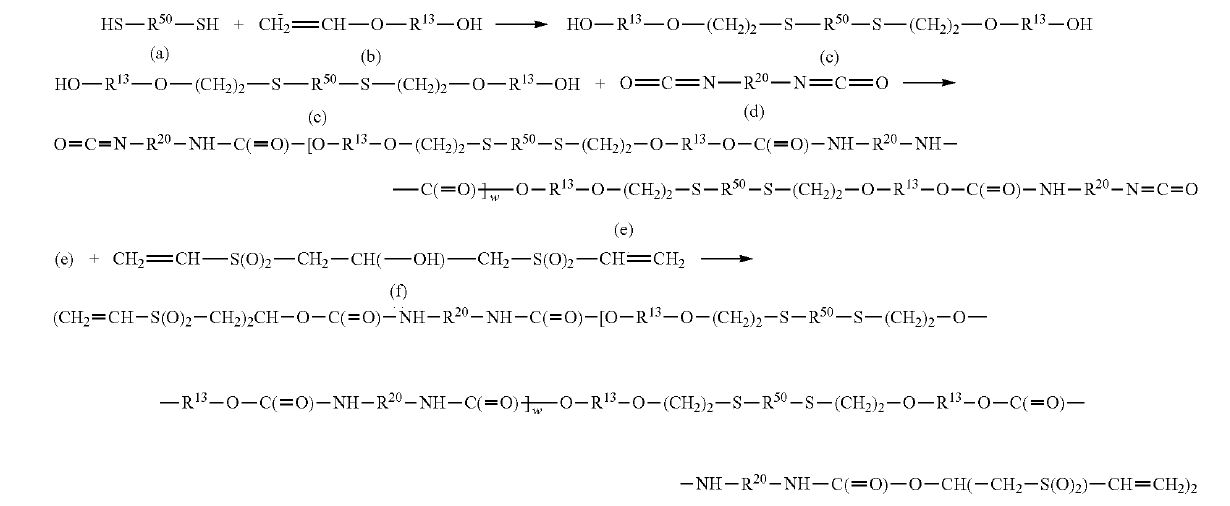
Michael acceptor-terminated prepolymer preparation according to the invention

Michael acceptor-terminated prepolymer preparation according to the invention

Cooperative Catalyst System for NIPU

Title: Catalyst for Non-Isocyanate Based Polyurethane

 Number/Link:US2015/247004

Applicant/Assignee: Dow; Univ. Northwestern

Publication date: 3-09-2015

Gist”: The cyclocarbonate-amine reaction is catalysed by a lewis acid/lewis base combination

Why it is interesting: It is well known that polyhydroxyurethanes can be produced from cyclic carbonates and amines.  These “nonisocyanate polyurethanes” can have advantages over conventional polyurethanes, e.g. as coatings with improved chemical resistance. The reactivity of (especially 5-ring)  cyclocarbonates is however much lower than that of isocyanates making the reaction much less practical.  According to this invention that problem can be solved by using a ‘cooperative’ catalyst system consisting of a lewis acid and an organic lewis base. In an example a difunctional cyclocarbonate-capped prepolymer is reacted with 1,3-cyclohexane-bis(methylamine) catalysed by a mixture of  lithium trifluoromethanesulfonate and triazabicyclodecene.
It has been noted before in this blog that Dow, as one of the major isocyanate producers, also appears to be interested in non-iso PU.

Triazabicyclodecene.

Triazabicyclodecene.

Rigid Foams Containing Lignin

Title: PROCESS FOR THE PREPARATION OF LIGNIN BASED POLYURETHANE PRODUCTS

 Number/Link: WO2015/021541

Applicant/Assignee: Enerlab 2000

Publication date: 19-02-2015

Gist”: Dried lignin is mixed with isocyanate before being reacted with a rigid polyol and HFC blowing agent to make rigid foams

Why it is interesting: Lignin is a cheap and abundantly available hydroxy-functional biopolymer and it is no surprise that many attempts are being made to incorporate it into polyurethane materials. This case claims that lignins, dried to a moisture content of (preferably) less than 1% (0.5% in the examples), can be mixed with isocyanates to form a relatively stable mixture with a decent potlife. The mixture can then be used to make polyurethane materials.  In the examples HFC-blown rigid PU and PIR foams are shown containing about 20% of dried lignin and with densities ranging between about 30 to 40 kg/m³.  Interesting development, however claim 41, which states that elastomers and even TPUs can be made with mixtures, is clearly over the top in my opinion.

Part of a typical lignin structure

Part of a typical lignin structure

  • Pages

  • Categories

  • Enter your email address to follow this blog and receive notifications of new posts by email.

    Join 259 other subscribers
  • Follow Innovation in PU on Twitter