Vulcanized Rubber Containing Isocyanate-Modified Filler

Title: FILLED ELASTOMER COMPRISING POLYURETHANE

 Number/Link: WO2013004714

Applicant/Assignee: BASF  (Chinese priority)

Publication date: 10-01-2013

Gist”: “Raw” rubber is vulcanized in the presence of  precipitated silica (preferred) which has been modified with an isocyanate prepolymer (pref) containing a hydrophobic and/or rubber-reactive moiety.

Why it is interesting: The rubber can be NR, BR, SBR, IIR, EPDM, etc which is vulcanized in the conventional manner in the presence of a filler, preferably a fumed or precipitated silica.  The filler has been mixed with an isocyanate-ended prepolymer prepared from a 2000 MW polyol and a di-isocyanate.  The polyol preferably contains a hydrophobic group (e.g. from a fatty acid) or a double bond (from a unsaturated diacid).  As a result the filler will be dispersed more finely and will have a strong rubber interachtion potentially greatly improving the rubber properties.  Useful for footwear e.g.

Vulcanized Rubber Boots (Wikipedia)
Vulcanized Rubber Boots (Wikipedia)

Insulating Polyurethane Foams Containing Impregnated Aerogel Particles

Title: METHOD FOR MAKING ORGANIC FOAM COMPOSITES CONTAINING AEROGEL PARTICLES

 Number/Link: WO2013000861

Applicant/Assignee: Dow

Publication date: 3-01-2013

Gist”: Polyurethane or polyisocyanurate (or -less preferred- extruded foams like EPS foams) are produced in the presence of aerogel particles impregnated with blowing agents resulting in composite foams with exceptional insulation properties.

Why it is interesting: The blowing agent evaporates during the reaction (or extrusion),expands the foam and prevents the aerogel particles of losing their porosity and low density.  Already 0.1% w/w of the particles is claimed to have a significant impact on insulation properties.  In the examples an HFC blowing agent is used together with aerogel particles with an average size of about 1mm.
It appears that composites of aerogels together with PU or PIR, but also with PS and rockwool e.g. are becoming an ever more important trend in insulation.

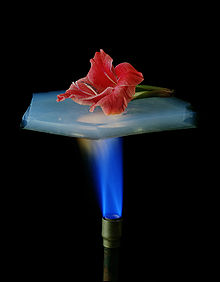
Aerogel (Wikipedia)

Aerogel (Wikipedia)

Self-Healing Polyurethanes, Polyureas and Polyimides

Title: SELF-HEALING POLYMER MATERIALS FOR WIRE INSULATION, POLYIMIDES, FLAT SURFACES, AND INFLATABLE STRUCTURES

 Number/Link: WO2012174325

Applicant/Assignee: NASA

Publication date: 20-12-2012

Gist”: A low molecular weight polyurethane or polyurea material, prepared by reacting IPDI and a polysiloxane diol or diamine in such a way that it flows at about 23°C, shows self-healing properties. Other ’embodiments’ of the invention are concerned with self-healing polyimides containing microcapsules comprising polyimide oligomers (“polyamic acid”).

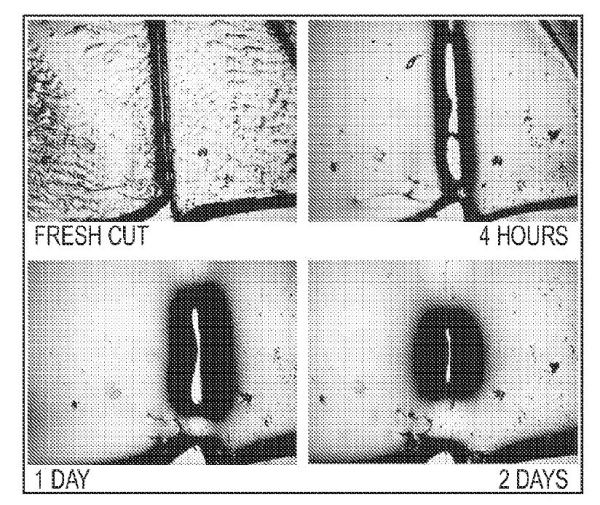
Why it is interesting: Films of the self-healing PU with a thickness up to 5mm will flow together again after being cut. The material can be laminated between 2 structural layers and used for cable and wire encapsulation e.g.
This is an interesting but very confusing and hard-to-read patent application describing at least 2 different inventions (“non-unity”) and one would expect it to be split-up.

selfhealing

Self-Healing Polymer Film

  • Pages

  • Categories

  • Enter your email address to follow this blog and receive notifications of new posts by email.

    Join 259 other subscribers
  • Follow Innovation in PU on Twitter