Hybrid PU-Peptide PUDs

Patent Title: AQUEOUS PEPTIDE-FUNCTIONALIZED POLYURETHANE DISPERSIONS

 Number/Link: WO2016/135162

Applicant/Assignee: Henkel; Max-Panck Ges.

Publication date: 1-09-2016

Gist”: A maleimide-capped prepolymer is reacted with the -SH groups in a peptide

Why it is interesting: Polyurethane-protein hybrids are interesting novel materials which potentially have a number of unique properties unattainable with conventional synthetic polymers. In a previous case discussed in this blog an NCO-ended polyurethane prepolymer was reacted with a peptide in water to make a PU-peptide dispersion.  This type of grafting, however, is not very specific because the isocyanate will react mostly with the free amino groups of lysine, which is usually  ‘abundant’ in a typical peptide. According to this invention the grafting can be made very specific by first end-capping the NCO prepolymer with maleimide groups and dispersing in water. The dispersion is then reacted with a peptide solution at pH7. In these circumstances the maleimide will react selectively with the free thiol group of cysteine, of which usually very few are present in a typical peptide because most thiol groups are engaged in S-S disulfide bridges.  Preferably a peptide consisting of 10-200 amino acids is used, with preferably only one free thiol group. By selective grafting the properties of the peptide can be conserved.  The PU-peptide dispersions are claimed to be especially useful for metal adhesives.
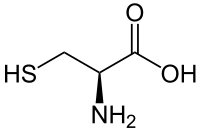
L-cysteine
L-cysteine


One Component Polyurea

Patent Title: CYCLIC DYNAMIC POLYUREAS FOR POLYMERIC UREA PROCESSING

 Number/Link: WO2016/126756

Applicant/Assignee: University of Illinois

Publication date: 11-08-2016

Gist”: 1K polyurea coatings from thermoreversible cyclic urea oligomers

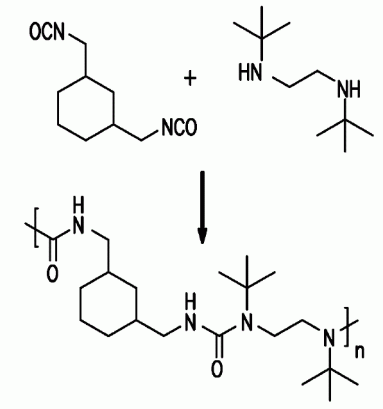
Why it is interesting: This application is related to W02016/069582 of the same applicant, discussed before on this blog. In this case the sterically hindered ureas are prepared in solvent and at a relatively low concentration. Under these conditions cyclic oligomers will be formed which can be separated and used as powder coatings, or, together with (e.g.) catalysts, polyols and crosslinkers, as liquid coatings. When heated the rings will open and the coating composition will cure. In an example 1,3-bis(isocyanatomethyl)cyclohexane  is reacted with N,N’-di-t-butyl ethylenediamine, in DMF, which forms cyclic oligomers at low-, and linear polymers at high concentrations.

Thermoreversible polyurea according to the invention

Thermoreversible polyurea according to the invention


Dispersions of Comb-Structured Polyurethanes

Patent Title: POLYURETHANE-BASED BINDER DISPERSION

 Number/Link: WO2016122569

Applicant/Assignee: Hewlett-Packard

Publication date: 4-08-2016

Gist”:  Aqueous dispersions of “1,2”-dihydroxypolyacrylate -based polyurethanes

Why it is interesting: According to this invention aqueous dispersions can be made of “comb -structured” polyurethanes which are based on polyols having two hydroxyl groups at one end of the chain.  The “1,2”-diols are made by copolymerizing (e.g.) methylmethacrylate and n-butylmethacrylate together with thioglycerol up to a Mw of about 2000. The polyols can then be reacted with isocyanate and dimethylolpropionic acid for dispersion in water. The dispersions are said to have a small average particle size (10-100 nm) and be especially useful as binders for inkjet-ink.

Thioglycerol

Thioglycerol

  • Pages

  • Categories

  • Enter your email address to follow this blog and receive notifications of new posts by email.

    Join 259 other subscribers
  • Follow Innovation in PU on Twitter