Bioabsorbable Thermoplastic Polyurethane

Patent Title: BIODEGRADABLE AND/OR BIOABSORBABLE THERMOPLASTIC POLYURETHANES

 Number/Link: WO2018/140912

Applicant/Assignee:  Lubrizol

Publication date: 2 august 2018

Gist”: TPU breaks down into non-toxic components

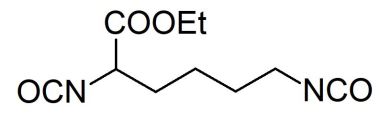
Why it is interesting: The invention is related to biodegradable TPU for medical use in vivo. The TPU is prepared from isocyanates, polyols and chain extenders that biodegrade into non-toxic products, e.g. hexane diisocyanate, butanediisocyanate, lysine diisocyanate, poly(ε-caprolactone), polyglycolide, dipropylene glycol, diethyleneglycol etc.  The TPUs are prepared at a hardblock content of 15-45% (pref).
I strongly doubt that this case is patentable because the same compositions are disclosed inanother Lubrizol application discussed before in this blog.
LDI

Lysine diisocyanate

UV Resistant Viscoelastic Foams

Patent Title: POLYURETHANE PRODUCT WITH SULFUR-CONTAINING POLYOL

 Number/Link: WO2018/111806

Applicant/Assignee:  Dow

Publication date: 21 June 2018

Gist”: VE foams using S-containing polyether polyols

Why it is interesting: According to this invention sulfur containing polyols improve the UV resistance of polyurethane materials.  It is believed that sulfur acts as a UV absorber incorporated into the polymer, thereby reducing the need for additives such as antioxidants.  In the examples an S-containing polyether diol is prepared by reacting 2,2′-thiodiethanol with propyleneoxide up to an OH value of  188 mg KOH/g. The diol is then used in an amount of 5 to 15% on the total polyol blend to prepare low resilience flexible foams showing an improved UV resistance.


TDE

2,2′-thiodiethanol


Proppant Coatings with Controlled Release

Patent Title: TIME RELEASED DELIVERY OF FUNCTIONAL CHEMICALS

 Number/Link: US2018/0127638

Applicant/Assignee:  Covestro

Publication date: 10 May 2018

Gist”:  Functional chemicals are reacted with isocyanates for controlled release in fracking wells.

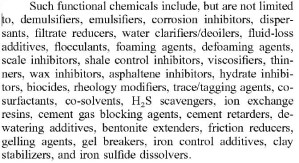
Why it is interesting:  Hydraulic fracturing for oil and gas production is a complex process that requires a “fracking fluid” containing a proppant together with a host of chemicals like defoamers, demulsifiers, biocides etc.  According to this application it is advantageous that these chemicals are released slowly over time during the complete lifecycle of the well. It is stated that this can be achieved by reacting the additives with mono- or polyfunctional isocyanates and (e.g.) incorporating these compounds into the proppant coating.  The additives should have an active hydrogen able to react with isocyanate, or be modified to have such.
The text does not propose a mechanism for this controlled release and it is not clear why this should work.  And -strangely- the “examples” section does not contain any examples.       

list

Some fracking fluid additives.

  • Pages

  • Categories

  • Enter your email address to follow this blog and receive notifications of new posts by email.

    Join 259 other subscribers
  • Follow Innovation in PU on Twitter