DOW on PHD and PIPA Polyols

Title: FINE PARTICLE, HIGH CONCENTRATION, POLYISOCYANATE POLYADDITION/POLYURETHANE-UREA POLYOLS

 Numbers/Links: WO2012154831WO2012154820, WO2012154393

Applicant/Assignee: DOW GLOBAL TECHNOLOGIES LLC

Publication date: all on 15-11-2012

Gist”: PHD or PIPA polymer polyol by reacting the particle forming raw materials in polyol and in the presence of small non-reactive particles acting as ‘seeds’.

Why it is interesting:  “PIPA”, “PHD” or “SAN” polymer polyols (i.e. polyols containing respectively polyurethane,  polyurea or styrene-acrlynonitrile particles) are used in flexible foams to increase loadbearing and sometimes to improve cellopening.  Dow claims to be able to make PIPA and PHD polyols with small average particles sizes (<100 μm) by using non-reactive ‘seeding’ particles of <10μm.  The resulting polymer polyols have low viscosity at a high solids content.  The seeding particles can e.g. be SAN particles.

Polyurethane Particles Produced Without Isocyanates

Title: POLYHYDROXYURETHANE MICROPARTICLES, AND PROCESS FOR PRODUCING SAME

 Number/Link: WO2012150684  (in Japanese)

 Applicant/Assignee: DAINICHISEIKA COLOR CHEM

Publication date: 8-11-2012

Gist”: Polyhydroxyurethane microparticles produced form cyclic carbonates and amines. 

Why it is interesting: For a number of years non-isocyanate (hydroxy-)polyurethanes have been promoted by Oleg Figovsky (a.o.) without much success. However now and then this chemistry pops up again, usually related to coating systems.

“Proppants” for “Fracking”.

Numbers/Links:  WO2012151260 WO2012151091 US20120283153 

Applicants/Assignees: PREFERRED UNLIMITED and  BASF,

Gist”: Coating sand particles, using isocyanate containing compositions,  to be used as “proppants” for “fracking”.

Publication dates: all on 8-11-2012

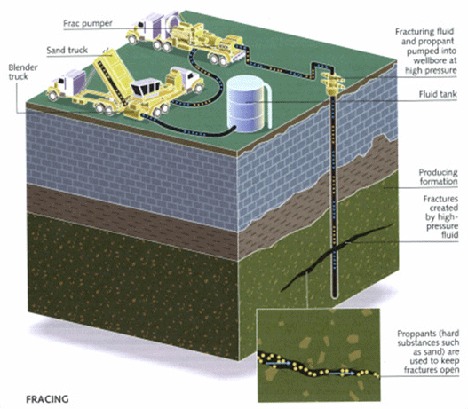
Why it is interesting: The production of  natural gas and oil by hydraulic fracturing or “fracking” has increased exponentially in the last few years and will probably turn the US into the largest oil producer in the world in the near future.  This is big business.  Fracking is done by pumping a slurry of sand, water and a load of chemicals under high pressure into oil containing rocks to produce fractures and release gas and oil. Using sand has the disadvantage of being abrasive to equipment and causing ‘back flow’. Coating the sand makes it better flowing, less abrasive and more adhesive to rock.  The BASF case e.g. uses waterglass together with isocyanate as a coating composition.

Fracking (Wikimedia)

  • Pages

  • Categories

  • Enter your email address to follow this blog and receive notifications of new posts by email.

    Join 259 other subscribers
  • Follow Innovation in PU on Twitter