Polyurethane for Precision Lenses

Title: POLYURETHANE HAVING LOW VOLUME SHRINKAGE

 Number/Link: US2013/116357

Applicant/Assignee: Bayer

Publication date: 9-05-2013 (priority PCT/DE)

Gist”: Modified m-XDI mixtures are used to prepare solvent-free polyurethane or polythiourethane with high refractive index, low dispersion and low volume shrinkage.

Why it is interesting: Production of polyurethane and (esp.) polythiourethane for optical applications is well known. Usually araliphatic isocyanates are used, often together with mercapto-functional compounds resulting in materials with high refractive index, low dispersion and low discolouration. Bayer has found that by modifying araliphatic diisocyanates, e.g. m-xylenediisocyanate, by partial trimerization or by partly converting into allophanate or biuret (after adding some diol or water respectively) optical polyurethanes or polythiourethanes can be produced without the use of solvent and with less shrinkage.  The materials are therefore more useful for precision optics.
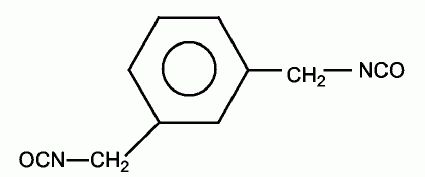
1,3-bis(isocyanatomethyl)benzene (m-XDI)

1,3-bis(isocyanatomethyl)benzene (m-XDI)

Vulcanized Rubber Containing Isocyanate-Modified Filler

Title: FILLED ELASTOMER COMPRISING POLYURETHANE

 Number/Link: WO2013004714

Applicant/Assignee: BASF  (Chinese priority)

Publication date: 10-01-2013

Gist”: “Raw” rubber is vulcanized in the presence of  precipitated silica (preferred) which has been modified with an isocyanate prepolymer (pref) containing a hydrophobic and/or rubber-reactive moiety.

Why it is interesting: The rubber can be NR, BR, SBR, IIR, EPDM, etc which is vulcanized in the conventional manner in the presence of a filler, preferably a fumed or precipitated silica.  The filler has been mixed with an isocyanate-ended prepolymer prepared from a 2000 MW polyol and a di-isocyanate.  The polyol preferably contains a hydrophobic group (e.g. from a fatty acid) or a double bond (from a unsaturated diacid).  As a result the filler will be dispersed more finely and will have a strong rubber interachtion potentially greatly improving the rubber properties.  Useful for footwear e.g.

Vulcanized Rubber Boots (Wikipedia)

Vulcanized Rubber Boots (Wikipedia)

More Isocyanate-Free Polyurethanes

Title: FUNCTIONAL POLYURETHANE PREPOLYMER, METHOD OF PREPARING POLYURETHANE BY USING THE SAME, AND APPLICATION METHOD THEREOF

 Number/Link: US2013004677

Applicant/Assignee: AMKANG UNIVERSITY (TAIWAN)

Publication date: 3-01-2013

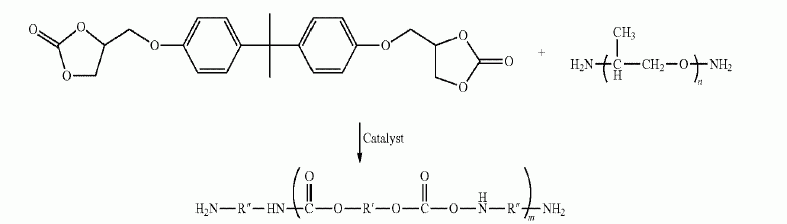
“Gist”: Bis(cyclic carbonate) compounds are produced by reacting  bisphenol-A diglycidylether with CO2.  These are then reacted with diamine oligomers (EO-PO and/or PDMS) to produce amine ended β-hydroxy-PU prepolymers which in turn are capped with acrylates to make a UV curable system useful for coating fabrics.

Why it is interesting: The materials are produced without “toxic” isocyanates and “harmful” phosgene (sic), but still need “harmful” amines and solvents. If made solvent-free, however, systems like this could make a lot of sense in e.g. synthetic leather production (IMHO).

isofreePU

Isocyanate-free PU from BPA-based cyclic carbonates and amines

  • Pages

  • Categories

  • Enter your email address to follow this blog and receive notifications of new posts by email.

    Join 259 other subscribers
  • Follow Innovation in PU on Twitter