Flexible Foams from Renewable Polyester Polyols

Title: METHOD FOR PRODUCING SOFT POLYURETHANE FOAM BASED ON POLYESTER POLYOLS

 Number/Link: WO2014/064130

Applicant/Assignee: Bayer

Publication date: 1-05-2014

Gist”: Flexible foams can be prepared from polyester polyols based on two different diacids and with a limited ester group content.

Why it is interesting: According to this invention flexible foams can be based on polyester polyols only if the polyols are not too polar or too ‘symmetrical’. This is achieved by preparing the polyols from at least two diacids chosen from (preferably) succinic-, adipic-, azeleic- or sebacic acid,  together with (e.g.) diethylene grlycol and some trimethylolpropane. Both the acids and the alcohols are preferably bio-based. The polyester polyols have an OH value of about 60 and an ester group content (polarity) of less than 9.8 mol/kg.  In comparative examples flexible foams based on polyester polyols containing only one diacid showed collapse.
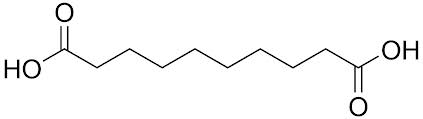
Sebacic Acid

Sebacic Acid

A New Type of Polyurethane Memory Foam

Title: VISCOELASTIC POLYURETHANE FOAM

 Number/Link:WO 2014/058857

Applicant/Assignee: BASF

Publication date: 17-04-2014

Gist”: Using TDI, two high MW and high EO polyether triols, hydrolizable PDMS and DELA results in a flexible foam with a low Tg ánd a low resilience.

Why it is interesting: While viscoelastic or “memory” foams are popular in the furniture industry they are currently not used in e.g. car seats because of their limited use temperature. Typically these foams become too stiff at lowish temperatures and often too soft and resilient at higher temperatures. The current invention is about viscoelastic foams which are useful for transport applications because they show constant properties over a wide temperature range. This is accomplished by reacting TDI with a (about) 4000 MW,  75% EO triol, an EO-capped 6500 MW, 75% EO triol, quite some diethanolamine (DELA), and quite some (2.5 pdw in the examples)  hydrolyzable polydimethylsiloxane copolymer (PDMS), together with water and catalysts. The foams show two Tg’s one at about -20°C and a minor one at about -55°C (probably due to a seperate PDMS phase) which keeps the foams resilient at low temperatures. The -20°C polyether phase is probably mixed with the DELA-TDI phase resulting in a wide transition reaching to over 0°C. This results in a resilience of  about 30% which is quite high for a typical ‘memory’ foam.

Polyurethane "memory foam"

Polyurethane “memory foam”

Classic PU Patent of the Month: The First “HYPOL” Foams (1974).

Title: Dental and biomedical foams and method

 Number/Link: US3903232

Applicant/Assignee: W.R.Grace

Publication date: 2-09-1975

Gist”: A branched, low NCO prepolymer made from all-EO polyol and TDI or pMDI is reacted with a large surplus of water to make a new class of flexible foams.

Why it is interesting: HYPOL™-type foams are very soft, highly hydrophilic flexible foams which can be produced catalyst-free from a high EO prepolymer and a high surplus of water. Originally the prepolymers were based on all-EO triols or tetrols and TDI 80/20, or -alternatively-  PEGs and polymeric MDI. Later these systems were further improved by myself in 1991 using 75% EO triols and 4,4′ MDI. The (after drying) low- to medium density foams are very robust and versatile, can be compressed and restored by adding water, and the specific production process allows to add all kinds of functionalities via the water stream. The HYPOL trademark is currently owned by Dow Chemicals and may encompass a wider range of materials than original.

US3,903,232

US3,903,232

  • Pages

  • Categories

  • Enter your email address to follow this blog and receive notifications of new posts by email.

    Join 259 other subscribers
  • Follow Innovation in PU on Twitter